
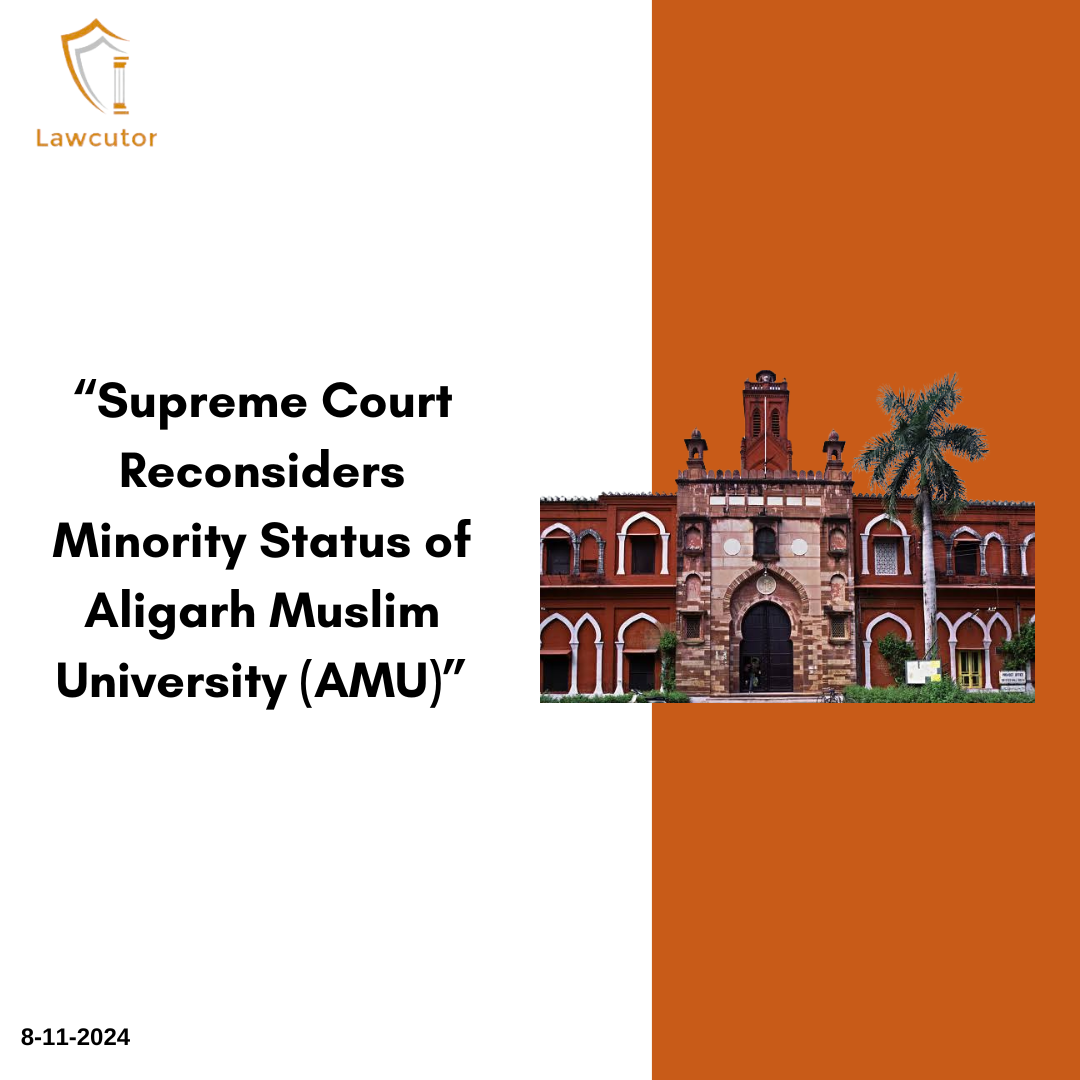
Background of the Case
The question of whether Aligarh Muslim University (AMU) qualifies as a minority institution under Article 30 of the Indian Constitution has been a long-standing legal issue. Article 30 grants minorities the right to establish and administer their own educational institutions, aiming to protect their cultural and educational rights.
In 1967, the Supreme Court, in S. Azeez Basha vs. Union of India, ruled that AMU was not a minority institution because it was established by a statute (the AMU Act of 1920) rather than by a religious minority group. This decision set a precedent that institutions created by statutory law could not claim minority status, impacting AMU’s ability to provide specific benefits to Muslim students.
In 2006, this position was reaffirmed by the Allahabad High Court, which cited Azeez Basha in its decision that AMU did not qualify as a minority institution, thus denying it the right to reserve seats for Muslim students.
The Recent Challenge
In 2019, a three-judge bench of the Supreme Court, led by then-Chief Justice Ranjan Gogoi, referred this matter to a seven-judge Constitution Bench. The question at hand was whether institutions founded by minority groups but subsequently incorporated by legislation (such as AMU) could still be recognized as minority institutions.
This larger bench was tasked with re-evaluating Azeez Basha and clarifying the criteria under Article 30 for a university to claim minority status. The main issue was whether statutory incorporation (such as the AMU Act) negates an institution’s minority status or whether the institution’s origins and founding purpose should still allow for that status.
Key Legal Questions
- Who Establishes Minority Status?: Should a minority institution be identified by who founded it (the “establishment” test) or by who administers it (the “administration” test)?
- Role of Statutory Creation: Does being created or recognized by statute prevent an institution from claiming minority status if it was originally founded by a minority group?
- Impact of Article 30: Does Article 30 only protect institutions established after the Constitution came into force, or does it extend to institutions with minority origins even if they were incorporated by statutory law?
Majority Judgment
The seven-judge bench, in a 4:3 split decision, overruled Azeez Basha. Chief Justice DY Chandrachud, delivering the majority opinion, declared that statutory creation does not automatically strip an institution of its minority status. According to the majority, the purpose of Article 30 would be weakened if it applied only to institutions founded post-Constitution.
Justice Chandrachud explained that the true test for minority status lies in identifying the original “brain” behind the institution’s establishment. He stated that:
“The view in Azeez Basha that an educational institution cannot be established by a minority if it derives its legal character through a statute is overruled.”
The majority laid out a clear set of criteria for determining minority status under Article 30:
Historical and Factual Origin: The court must examine who initially conceived, funded, and established the institution. If the evidence shows that a minority community played a pivotal role in its founding, the institution can be regarded as a minority establishment.
Nature of Establishment vs. Incorporation: Just because a university was later recognized or formalized by a statute (such as the AMU Act) does not change its founding by a minority group.
Administration’s Role: While Article 30 protects the right of minorities to administer their institutions, administrative control alone does not determine minority status; rather, it is the initial establishment by a minority group that qualifies it.
Thus, the majority emphasized that AMU’s origins should be assessed in depth. If it was indeed established by a Muslim minority group, it may retain its minority character even though it was later incorporated by statute.
Dissenting Opinions
Three judges—Justices Surya Kant, Dipankar Datta, and SC Sharma—dissented, each presenting distinct views:
Justice Surya Kant argued that while Article 30 does protect institutions established by minorities, statutory recognition (like UGC approval) is essential. He believed that Azeez Basha needed some modification but should not be completely overruled.
Justice Dipankar Datta took a strict stance, declaring that AMU is not a minority institution. He also felt that previous references to higher benches (1981 and 2019) were unnecessary, suggesting that the Azeez Basha decision should stand.
Justice SC Sharma held that for Article 30 protection, minorities must maintain both establishment and administrative control. He argued that minority institutions must be self-governed by their respective communities and provide secular education if required, emphasizing that both founding and ongoing control are essential.
Next Steps for Determining AMU’s Minority Status
Following this ruling, the Constitution Bench referred the specific question of AMU’s minority status back to a regular bench for final determination, instructing it to apply the new guidelines established in this judgment. This regular bench will now examine whether AMU’s factual origin aligns with the criteria for minority status.
Key Legal Representation
In this case, Senior Advocates Dr. Rajeev Dhavan, Kapil Sibal, and Salman Khurshid represented AMU and its alumni. The Union of India was represented by Attorney General R. Venkataramani and Solicitor General Tushar Mehta, among other senior advocates who presented arguments against AMU’s minority claim.
Conclusion
This judgment marks a major shift in interpreting Article 30, focusing on an institution’s historical origins rather than the formalities of its legal incorporation. The ruling asserts that statutory creation does not erase an institution’s minority origins if it was originally established by a minority group, opening a new path for assessing the minority status of institutions like AMU.
 Lawcutor